Wednesday, June 15, 2016

Little Boys and Nail Polish: This is Why I'm Moving Back to Berkeley


OK, there are actually a lot of reasons why I'm moving. It's where I'm from. It's where my oldest friends now live with their kids. It's where we have family.

It's also a place where I grew up understanding from a young age that people can and do express themselves in different ways. It's place where I could take art and dance as a kid and not feel weird about it. It's place where I grew up knowing that homosexuality was normal. It's a place that, on the whole, was more accepting and tolerant than any place I've ever lived.

I want that for my kids. It's been tough for us uber-liberal hippy types the last few years. Below is an email my wife sent to out previous day care. The goal isn't to trash the center so I am removing the identifying information. Her email was wonderfully written, and is a great example on how to approach these problems.
"Dear Daycare Director, 
I'm writing to share some feedback about an experience at [Daycare] that is now years old. Since the events I'm sharing are long in the past, I don't expect that any specific immediate action needs to be taken, but since they have had a profound effect on my child I am sharing with you anyway. 
Our son, nicknamed Buddy, attended [Daycare] full-time from 2011 through 2014. He generally had a wonderful time at [Daycare]: had positive experiences, created wonderful memories, and built lasting relationships with both his peers and his caregivers. We were especially grateful that some of those caregiver relationships were very long-standing, as he had one classroom teacher who happened to transition from his Toddler classroom into his Preschool classroom, so the two of them got to know each other very well. 
Our son has always had a flair for self-expression, and during his preschool years he experimented with fashion. Like many young children, he enjoyed decorating himself with nail polish on his nails, barrettes in his hair, and sparkly things everywhere. We knew that this behavior being outside American gender norms, he might come in for some questioning or even bullying from his peers, but we were completely blindsided when we learned that some of this bullying came from his teachers. When I personally heard a teacher saying "Buddy, why are you wearing your sister's barrettes? Those don't belong to you," I made a point to take him shopping for HIS OWN barrettes and show them to that teacher, saying "These are Buddy's barrettes that he picked out for himself, so please don't tell him they don't belong to him. They do." Buddy picked out his own outfit to include a skirt one day (as he had worn to many non-school locations prior to that), and as I dropped him off I was very nearly in tears, afraid about what was going to happen that day. I had a quick conference with his most supportive teacher and asked her to please look out for him that day, and help him if he decided he'd rather change into jeans. He came home still wearing the skirt, but did report that some students and teachers reacted negatively, and he never ever chose to wear that kind of outfit again--not at school or anywhere else. I will never know exactly what was said to him that day, but I have to wonder, since this particular experiment of self-expression didn't phase out or anything... It stopped on a dime that day. 
I am bringing this up now because I had a painful conversation with Buddy last night. He has current classmates who are very insistent about gender norms. Okay, these kids are six and seven years old, so we don't expect them to be particularly enlightened or supportive. But he told me that he doesn't like nail polish anymore (true--he has steadfastly refused all nail art for three years) because "Ms. S" asked him if he was a girl when he wore nail polish to preschool once. Ms. S was his teacher who worked with him for years at [Daycare]. He then proceeded to say to me, "She told me I can't have nail polish on my fingers and then she made me take off my shoes and socks to see if I had any on my toes. She made me feel embarrassed!" A [Daycare] teacher ordered a child to take off items of his clothing, in front of his peers, in order to shame him about a completely innocuous decoration. 
"She made me feel embarrassed" is a devastatingly understated way for a seven-year-old to describe his own public humiliation, isn't it?

So I'm writing to you with this new information, not because I'm requesting any formal discipline or any specific actions at all--just because I feel that you need to know that this happened at the hands of your staff. The one request I'll make of you is that you respond to this information with a promise, to me and Buddy's father, not to let it happen again to any other child in [Daycare]'s care.
Thank you so much for always having been responsive to my concerns over the years. Despite this disappointing experience, we have a lot of love for all our friends at [Daycare]."
Later in the day we received this response from the day care director. 
"Good afternoon, 
I'm so sorry to hear that this happen to our wonderful Buddy.  I'm just sick to find out that a caregiver here at [Daycare] left devastating effect on Buddy's life.  I'm glad you are bringing this to my attention because I this can now change what's happening in our facility because every child need to feel valued.  Please be reassured that I'm going address this matter with all my staff because children need to feel valued in all their choices. Again, thanks for giving us the opportunity to be a part of your children's lives and if  there is anything I can do to help just let me know and I will be there for you and your family."

The response helped, but as my wife said to me later, "I'm tired of having to fight these battles on his behalf."

Thursday, June 2, 2016

Birthday Parties are a Waste of Money

I've seen it firsthand. I've been right in the thick of things, surrounded by chaos. The screaming, the crying, the damage done to person and property.
I was a birthday party entertainer. 
For two years during college I worked for a company that provided edutainment science programs for kids in after school programs, summer camps, and birthday parties. For two years I put on the same show three to six times each weekend as I drove all over the Los Angeles area in a 1989 Civic with no A/C.
In that time I saw everything. From families who had likely saved all year to hire me as a treat for their kid, to lavish spectacles where I was one of several acts and felt lost in the shuffle. I was often paired with, or pitted against, some sort of inflatable structure. Some parents were engaged in the show, others used it as a time to grab a drink and chat with friends. That's how I once ended up being the only one to notice a bouncy house full of children tipping over and deflating. I sprinted across the yard and pulled eight kids out of the rapidly collapsing 500 pounds of PVC before anyone came to help out. Still, I realized I had it easy when I left a party with Batman and Buttercup the Power Puff Girl. When Batman got around the corner to his car he removed his rubber cowl and so much sweat poured out it looked like he had dumped a bucket of water over his head. The guy in the Buttercup costume didn't seem to be doing much better. By comparison my teased out half-fro and lab coat seemed like a blessing.
Even as I was doing it I couldn't believe that this was a thing. Hiring from our company wasn't cheap, and of course there were up-sells and add-ons on top of the base price. I was paid for each performance, plus tips, which I relied on. Whether I was treated like a star or an after thought I knew I wouldn't have a version of me at my kids' future parties. As much as I appreciated being able to pay my way through school on the wallets of these families I think it was a waste of money. Becoming a parent has only hardened my resolve. Parties at gyms, bouncy places, or climbing establishments run $250 and up in my area. No way my friend. I bristle at spending more than $50 for snacks, there's no way I'm buying trampolines and pizza for twenty.


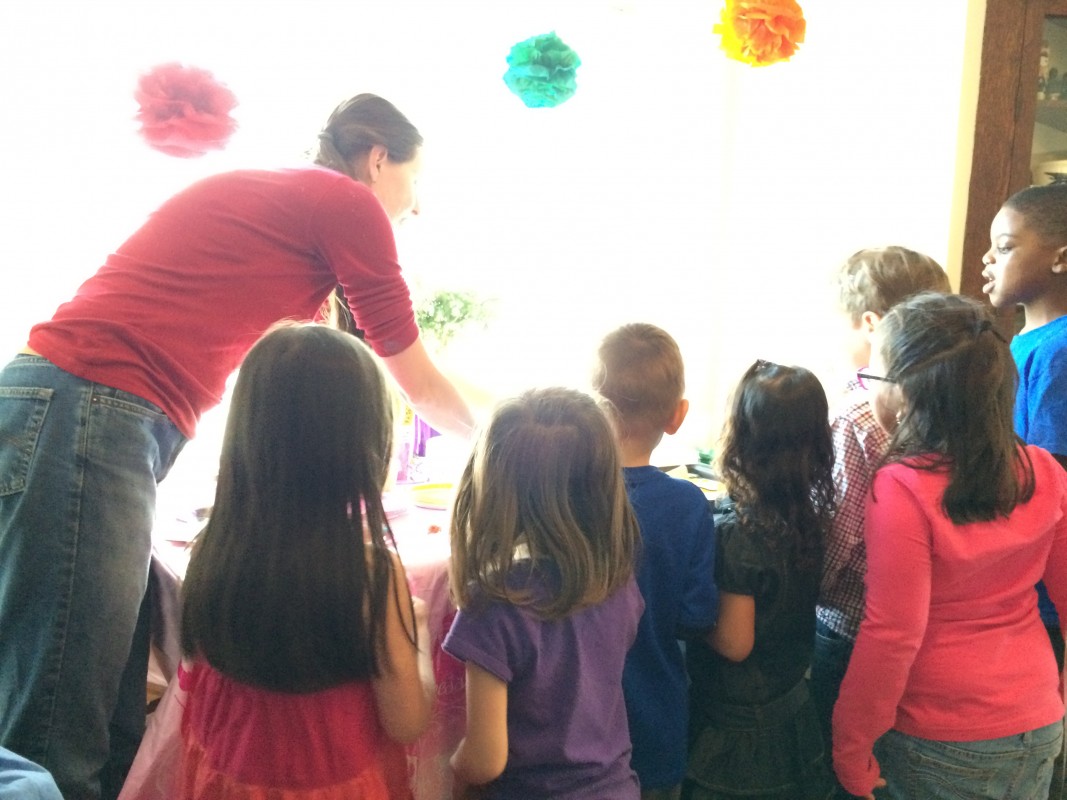
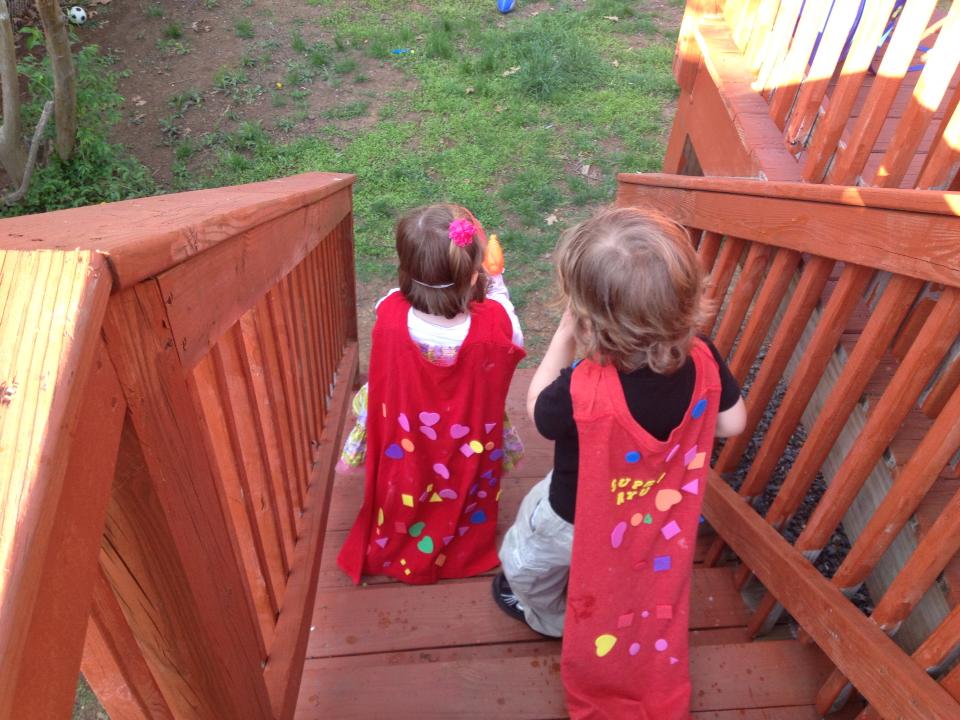
I'm not a total party pooper. It's just that I still believe in the power of the old school parties we had growing up, at home. My two oldest children have birthdays five days apart. For them we have one party on the closest weekend to their birthdays. This way all their friends can come over and destroy my house once and I'm done for the year. For a couple years we prepared activities for the kids. Once our kids chose to perform a play for their guests. Over the years we've found that the activity is usually ignored in favor of just running around the house, or the yard (or the house and the yard). The last party involved half the guests grabbing light sabers and muskets and waging war on an imagined enemy, while the other half sang karaoke into a purse/boom box. Other times we've simply rolled some balls out in to the yard, or helped the kids make super hero capes. The point is, kids don't need a bunch of froo-frah to have a good time. All kids really need are some friends and enough space to roam around. And cake, kids go ape for that stuff. Our home and park based parties are enough. My kids have never asked for anything else.
RMSHeroParty
Super Hero Party
I get that there are different families with different needs. Some people have more money than time and would rather not have a gaggle of rug rats run through their showpiece homes. Some people just hate cleaning up. For us, a single income family with a stay at home parent, we'd rather spend that $250 on a season of dance lessons, or art classes, or sports dues and equipment. Hell, you'd be better off putting that money in a 529 plan and giving it to them when they're eighteen. Elaborate birthday parties are a waste. I don't think most kids really care all that much, and I'm not willing to get caught up in keeping up with someone else's lifestyle. I'm lucky that my kids feel the same way. Besides, why hire entertainment to occupy them while I grab a beverage with the other parents, when they can entertain each other for free?
Capes

Thursday, May 5, 2016

Guesting on the Uncle Nacho Podcast

Me, Uncle Nacho and Grandma Yo
There are potential big moves going on here at IDL headquarters and I haven't been free to write much here lately. I'll be excited to reveal all that's been happening as it closes in on being released, but for now I'm excited to share my recent appearance on the Uncle Nacho podcast.

Full disclosure, Jiro Ignacio Palmieri aka "Uncle Nacho" is my younger brother. He's been involved audio, media, and radio for a few years now. He had a radio show in the San Francisco bay area on KPOO radio. Now he hosts the Uncle Nacho podcast, which "examines the intersections between sports, politics, art, and culture." The interview is a great overview of how I came to lead An Interdisciplinary Life and what that's meant for me. It's sort of this whole site here compressed into an hour of story telling. So if you've enjoyed reading IDL think of this as IDL on the go, a chance to get your Berto time and also do dishes.

This is part one of our interview. In this episode I talk about going to elementary school as a vagabond in Europe for a year and comparing it to American public schools. We discuss racial identity, how flipping over a white water raft full of Deaf kids led me to a career as an interpreter, my dad teaching me how to make a zip gun, and the creation of "Your Mom is So Berkeley." We also touch on alternative educational paths, growing up with a single mother, and a Berkeley High School legacy I had totally forgotten about. Within all of that we do indeed intertwine sports, arts, and culture.

If you scroll down past the embedded podcast there's some expanded info on things we didn't have answers to during the podcast.
 

There was a question that came up about how my family ended up in Chicago. I asked the branch of the family that stayed in Chicago and got a great response relating to Japanese American history. From my cousins Midori, Vince, and Rea who are all amazing artists and writers. The block below is edited together from their responses to my question.

Because jobs and housing weren't available to Japanese Americans post WWII on the west coast a Japanese community developed in Chicago around that time probably to support each other. Vince and his wife were in Hattiesburg Mississippi and they heard there was more work in Chicago for JAs (editor’s note: Vince is my grandma Yoshiko’s brother). Also, the American government had already taken our family’s home and real estate. They came up and settled in Hyde Park/South Side along with many other friends from camp and Hattiesburg. Hattiesburg was the home of the 442nd all Japanese Battalion. I'm not sure what Vince's first job was in Chicago before he became photo editor at Playboy. He only moved back to California once his job made that available to him. Yoshiko must have joined them at some point.

The folks who ran the camps were mostly liberal, though their good intentions generally did as much harm as good. They had an idea that you could solve racism by sending JAs out of camps into areas away from the West Coast, a few at a time and that they'd be accepted and assimilated if they kept apart from other JAs. This was obviously a terrible idea because (1) segregation wasn't a choice and (2) you try living among people who hate you without allies. So, there were serious programs to resettle folks out of camp, but the ones who left had to create new communities. The largest migration was to Chicago, which was possibly the most important JA city for a couple of years after the war, before everyone who hadn't made a stake there pretty much decided to go back to the West Coast. I think Larry's (another of Yoshiko’s brothers) JACL ties also meant a lot--there were some serious divisions among JAs about how to respond to incarceration and I suspect going to Chicago probably said something about you/your family.
Thanks for reading and listening. If you have any other unresolved questions from the interview let me know in the comments. I'll post the second part of the interview when it becomes available.

Friday, April 8, 2016

Suicide and Survivor's Guilt

One of the few times we were all together after my first birthday.
There are aspects of life that highlight the contrast between the things you know and the things you feel. There are trivial ones, like sports fan superstitions, and then there's things like coping with suicide. It's common for the people left behind to carry guilt. We feel like we should have been able to do something. If only we'd seen it coming, if we'd called, said something, answered the phone, whatever it is we feel we should have been able to do to prevent it. We feel this way even though it's probably not true. It's not our fault. It's the difference between what we know and what we feel.
My uncle committed suicide shortly before I was born. As long as I've been a conscious person I've been aware that people sometimes kill themselves. It became part of the backdrop of my life, something that was always a possibility. When I was twenty a friend hung himself in the stairwell of my house. We always believed that the 15 bedroom house was so big, and busy at all hours, that he expected to stopped. Or he was making a statement. Either way, I didn't feel guilty, or angry. It was just something that happened. We all knew that the way we lived as adolescents, some of us weren't going to make it to adulthood. I didn't blame my friend, I knew there was something wrong inside him that he couldn't control.
My dad was different. I had been married a few months when I came home and found a police officer's business card stuck in my screen door. It was the coroner's office. They wanted me to come identify the body. I was a thirty-year-old orphan. It wasn't fair. Not just that he'd died, but that he'd lived as long as he had, while my mom died of cancer at 54. My mother did everything "right." She was vegetarian, a swimmer, she drank her one glass of wine. She raised me. 
My dad was the opposite. He wasn't around when I was a kid. At one point I hadn't heard from him in so long that I started telling people he had died. Growing up in the South Bronx projects, he was at times a gang member, a heroine addict and an alcoholic. He claimed he'd been shot once. He didn't eat well or exercise. But he was indestructible. I was six-years-old when he first beat cancer. He lost a lung that time. At twelve I came home one night and found him comatose from vodka and pills. My senior year of college he did it again, they told me he wouldn't live through the weekend. I was told that four weeks in a row before I stopped driving the 400 miles home on Fridays. They later found him wandering the ICU looking for cigarettes. He'd woken up from an induced coma, pulled out all the tubes, and set about finding some smokes. That's also when he beat cancer the second time. They'd found he had prostate cancer but didn't treat it until they knew he'd recover from the pneumonia.
In later years he survived diabetes and a car accident that destroyed his car and lost him his license. By 2008 he was losing his sight and a foot. We had been in touch sporadically over the years, trying to repair a broken past. I wasn't as attentive as I could have been in the year after my mother passed. I was also newly married and we were waiting out the three months before telling people we were expecting a baby. We were three days from the big announcement when I found the card in my door.
I could have called him earlier and told him he was going to be a grandfather. I still can't shake the feeling that I might have been able to give him something to live for. After every incident my dad would say, "Nothing can kill me. I'm from the Bronx." He was right. The only thing that could end his life was his own desire to die. I don't know if he was depressed about our fractured relationship, or if he was weary of his rapidly deteriorating body. Maybe it was a quality of life issue. Maybe staying alive for his grandson would have been a burden rather than a relief. The problem with suicide is you rarely get answers. None of the four suicides that have touched my life have involved a note. Without one no matter how much I know I couldn't have changed it, I feel like I might have.
I didn't know my dad well at the end of his life. I did love him. I do miss him. I miss having that link to my childhood. I miss being able to compare my son to myself at the same age. I have no one now who can tell me if he's just like me. To this day, no matter how much I read to the contrary, I carry the guilt of not having done enough to save him.
It's not my fault. It's not yours either.

Thursday, March 31, 2016

Her Cleft was a Surprise, Her Strength was Not


Yesterday Lou had her fourth surgery related to her cleft. Recently I thought back to the day she was born, and how her condition caught us off guard. T had to be strong for Lou that day. Lou has been strong for us ever since.

It was a surprise. Not just her condition, the whole thing was a surprise, for me anyway. We were in the middle of moving across the country when my wife called to tell me she'd been feeling nauseous. Starting a PhD program wasn't going to be the only big endeavor that year. If I'd been planning we might have waited, but when I told people this my wife corrected me, "This is exactly when I wanted to have the second."

That spring I warned my professors and classmates that I might disappear for a couple weeks after spring break. I also ruined the Fourth of July for any of them who also had mid-April birthdays (if that's you, maybe your parents like fireworks too). I made a lot of jokes during those 40 weeks. It's how I respond to stress. One that I kept coming back to was that the baby would have a cleft palate. I don't know why I was fixated on that, but any time I expressed anxiety over the birth that's what I went to. It wasn't totally out of nowhere, my uncle had been born with a cleft.

From the beginning this labor was different than our first. It progressed very quickly and lasted just four hours in total. By the time the midwives arrived at our apartment T was already in transition and ready to push. When Lou emerged we were thrilled to have our first daughter. She was healthy and screaming and  purple, just like you expect. When I looked at her little wailing face announcing herself to the world something seemed out of place. "She's got something stuck under her nose" the midwife said trying scratch it away. I knew what it was, "She has a cleft."


My heart sank. Not because the cleft was a huge problem, as I said, my uncle had one, in the fifties, and he's fine. I was worried about the scars she'd have, but more than anything I was gripped an irrational thought, "I caused this." It was my fault. It was because I had made all those stupid jokes. No one really knows why clefting occurs. It's an almost random one in 700, but two of the risk factors are family history (ding!) and being Asian (I'm half Japanese), so in a way it is my fault.

Clefting is usually diagnosed on the 20 week ultrasound. I found that out on the Internet a few minutes after my Lou was born. Sure enough, it's clear on the pictures if you know what to look for.   It shouldn't have been a surprise, the tech should have caught it. We should have had time to prepare. Instead all we knew was what we could find online, so naturally I was panicked. The one useful thing we learned is that Lou wouldn't be able to nurse. The open spaces in her lip and her oral cavity made it impossible to create a seal or to generate the vacuum needed to suckle. If we'd labored in a hospital they'd likely have been able to resolve it there. But Lou, like all of our children, was born at home. Now it felt like a race against time. The baby needed to eat and we had no idea what to do.

We called our pediatrician. He told us he'd look into it and asked if we could come in. My wife tells me we went, though I have no memory of being there. When we arrived he told us he had set up an appointment at Children's National Medical Center. We were lucky, Lou had been born on a Tuesday, Cleft Clinic day at CNMC. By the time Lou was three hours old we were starting a day-long series of meetings with the team who would handle her care for the next 19 years. We learned that she will need between 7 and 9 surgeries during that time span. We learned that she will always have scars. Most importantly we learned how to feed her using special bottles called Haberman Feeders, that look like tiny turkey basters. Ever the joker, I nicknamed her "Zoidberg" after the Futurama character. The most amazing part of that visit was T. There she was, sitting in the examination room taking it all in just three hours after giving birth. Each time a new doctor came in looking at the chart they'd pause, look confused, and then ask T, "Is this right? She was born three hours ago? Why didn't we come to you?" T would explain the home birth and the doctors would gaze at her as if she were a unicorn.

Having a cleft baby isn't easy. My wife pumped 11 times each day for the first six months, before tapering off to 8. We had to plan our lives around being able to pump, which is more complicated than it sounds. We couldn't be away from electricity for more than a couple hours at a time. T pumped in the car while commuting. She pumped at baseball games. She pumped everywhere. Still, it's also not as hard as raising children who have more serious conditions. Lou has a speech impediment. She has an IEP for speech therapy, but she'll grow out of everything except the scars. She's grown to be a resilient and vibrant girl. She doesn't mind talking about her cleft. Whether it's enduring two major surgeries before she was a year old, or something she would have had anyway, she's fearless. We started calling her "Crash" based on her propensity to push her physical limits, then get up and dust herself of with a resounding, "I'm OK!" She is. She was always going to be. I shouldn't be surprised.


Saturday, March 12, 2016

Star Wars Canteen and Cabin Fever

Halloween. Good times
Maybe you heard that we got a huge blizzard here on the east coast about a month ago. School was closed for a week, it was actually a nice break. I love when the kids are home and it's all of us just hanging out. The kids like it too. Even with all the love of being home we do end up looking for things to do. This blizzard gave us a chance to take on a project we'd been talking about for a few months, the kids' version of Eddie Izzard's "Death Star Canteen" bit.

If you haven't seen, then for crying out loud, click the link. It's brilliant. If you prefer there's also an animated version and a fantastic stop-motion Lego version.The problem for me as a parent is that there's some cursing, so I can't play it for the kids. The bigger problem is that I forgot about the cursing, played it for one kid, then had to play it for the other kid. Then they both started dropping casual f-bombs. So we had to clean it up. First, we found a transcript online, and I bowdlerized it. We had fun doing readings of that for a while, and then reciting it on weekend mornings while making breakfast. Once Buddy decided to be Darth Vader for Halloween we knew we'd end up doing a filmed version. The blizzard finally gave us the time.

Now look, I don't know how this goes for the Holderness family, but making a movie like this with a four year old kind of sucks. Also, Buddy is kind of a perfectionist so not getting it in one take was frustrating. The main problem for Lou was waiting for her part, and being quiet. But after a few dozen takes it finally came together. So below I present to you a clean, kid friendly version of Eddie Izzard's Death Star Canteen.


Friday, February 26, 2016

I Didn't Know Oren Miller

Photo by Chris Bernholdt

I didn't know Oren Miller. Oren died a few months before I would have had a chance to meet him. Oren was a blogger, and a father, and many other things that I don't know about because I never got to know him.

Last weekend I went to the Dad 2.0 Summit, a conference for bloggers and brands to come together and talk about "the changing voice and perception of modern fatherhood." I was there because I was introduced to a Facebook group of dad bloggers. The group was founded by Oren as a place were these dads could come together for support. There's a lot of discussion about writing, about growing an audience, about the mysteries of SEO (search engine optimization). Guys share their writing and comment on each other's posts. There's also a lot of personal support. There are parenting discussions. It's also a place where guys can vent about family or work or anything else they can't express to people in other parts of their lives. And it's not just complaining about things, there's real raw emotion there at times, and the support they get from the group is inspiring.

Photo by Isom Kuade
I attended Dad 2.0 as a recipient of a Miller Grant, a scholarship to help writers attend the conference. Without the grant I would have been hard pressed to attend. Our family lives on one income, so it's a luxury for a stay at home dad like me to lay out money to attend a writing conference. I was also selected to read a piece I had written as part of the conference's Blogger Spotlight. It was a fantastic experience for someone like me who is still almost wholly unknown in the blogging world. It was like fantasy camp for bloggers. Having a chance to meet with other writers, to make connections with brands, and to get mentoring from PR people and industry insiders would have been worth more than what I would have paid if I had not received the grant. Being there for free was like winning a sweepstakes. Just attending that weekend and being chosen to read doubled my social media engagements and followers. It's meant getting retweets and shares from people with much greater online presence than I have. It's also meant deeper connections with a large group of dads I had only known through avatars and online comments. It was chance to not only grow as a blogger, but to extend a network of friendship and parenting support throughout the country (and Canada, Hi Canada!).

None of this would have happened if not for Oren Miller. If not for his idea of a "A blogging dads group. So crazy it just might work" I wouldn't have had this experience. If not for the support and inspiration I gleaned from his group I may not have written your favorite post on this site. All the things I've posted in the last year might have remained stray stubs of thought rattling around my head along with random baseball statistics and grocery lists. Instead, they're here. I'm here. You're here.

One of the themes of the conference was legacy. The Friday keynote speaker, Brad Meltzer noted that your résumé fades after you die, your legacy is determined on the impact you have on the people around you. He's right, but I think there's room for both. The dad bloggers group is part of Oren Miller's résumé. It's also an artifact of the impact he's had on the people around him. It feels weird to say, because I feel like I'm laying claim to something I don't really deserve, but I am part of Oren's legacy. Anything I accomplish as a blogger, any writing that reaches an audience as a result of this space has its roots in the dad bloggers group that he started. Without Oren there's no Interdisciplinary Life.

Someone asked the conference attendees what their one missed opportunity or one regret was about the conference was. I didn't answer because I still felt too unworthy to say it publicly. Claiming a little piece of Oren's legacy felt like I might be trying to take it from the people who really knew him. It made me feel like a poser. My biggest regret is that I didn't write this post in the Oren Miller tribute book that was going around the conference, and was later presented to Oren's wife Beth. My biggest missed opportunity was being too afraid to approach Beth after her heart wrenching reading of a letter that Oren had written to himself several years before. I didn't have the confidence to approach her and tell her that even though I never knew Oren, that I owed him, and her, a debt of gratitude.

I understand now that by appreciating the community he built, by taking a place with those he brought together, I can never take anything from those who loved him. If anything, I hope they see his legacy being amplified. It still feels weird to write this.

Thanks Oren.